BUYING GUIDE · 11 MIN READ · UPDATED SEPTEMBER 2026
Table of Contents
- What “Custom” Actually Means for Plush Dog Toys
- Fabrics, Filling and Squeakers: The Material Decisions
- Safety and Construction Details Buyers Must Specify
- MOQ, Sampling and Tooling
- Lead Times and Payment Terms
- Quality Control: What a Serious Supplier Checks
- What Actually Drives the Unit Price
- Private Label Packaging and Retail Readiness
The short answer: when you source custom plush dog toys, judge a supplier on three things before you compare prices — (1) real sampling capability, meaning they can turn your sketch or reference toy into a physical pre-production sample, not just print your logo on a catalog item, (2) honest MOQ and material transparency, so you know exactly which fabric, filling and squeaker you are paying for, and (3) verifiable quality control, with inspection gates you can audit before the container ships. Plush is a hand-labor-intensive category: the factory that controls cutting, sewing and stuffing under one roof will always beat a trading office on consistency and lead time. Stock designs at our facility start at 10 pcs; private label and OEM orders start at 500 pcs; quotes come back within 24 hours.
Section 1/8What “Custom” Actually Means for Plush Dog Toys
“Custom plush dog toys” means different things to different buyers, and the difference shows up directly in your MOQ, your unit price and your timeline. There are three practical levels:
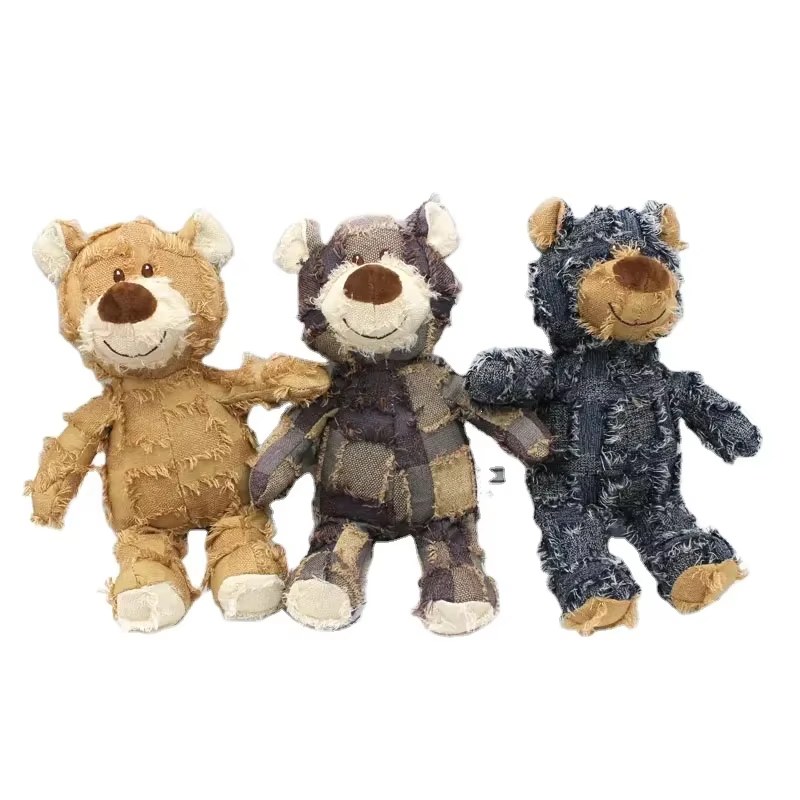
Level 1 — Private label on a stock design. You pick an existing toy — for example our patchwork plush bear with vocal gnawing design — and add your brand through a woven label, embroidered logo or custom packaging. The pattern, fabric and tooling already exist, so this is the fastest and cheapest route to a branded line.
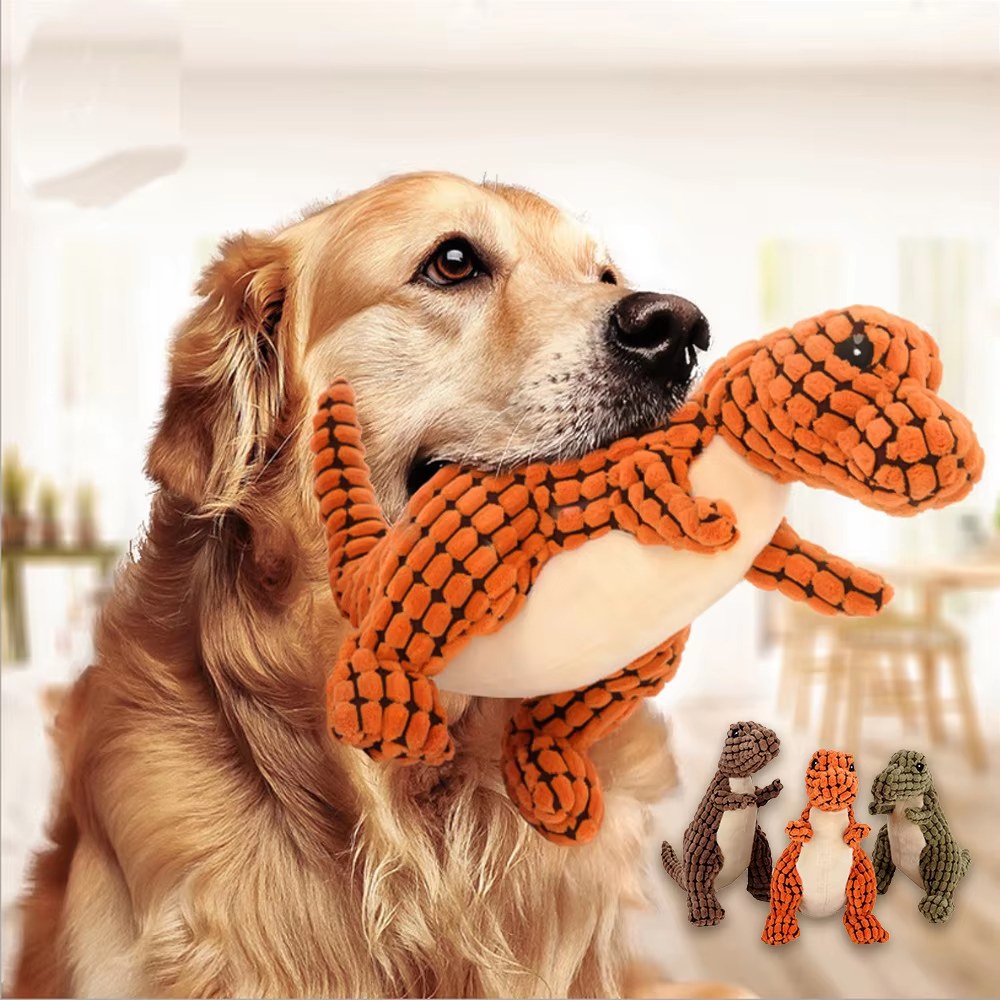
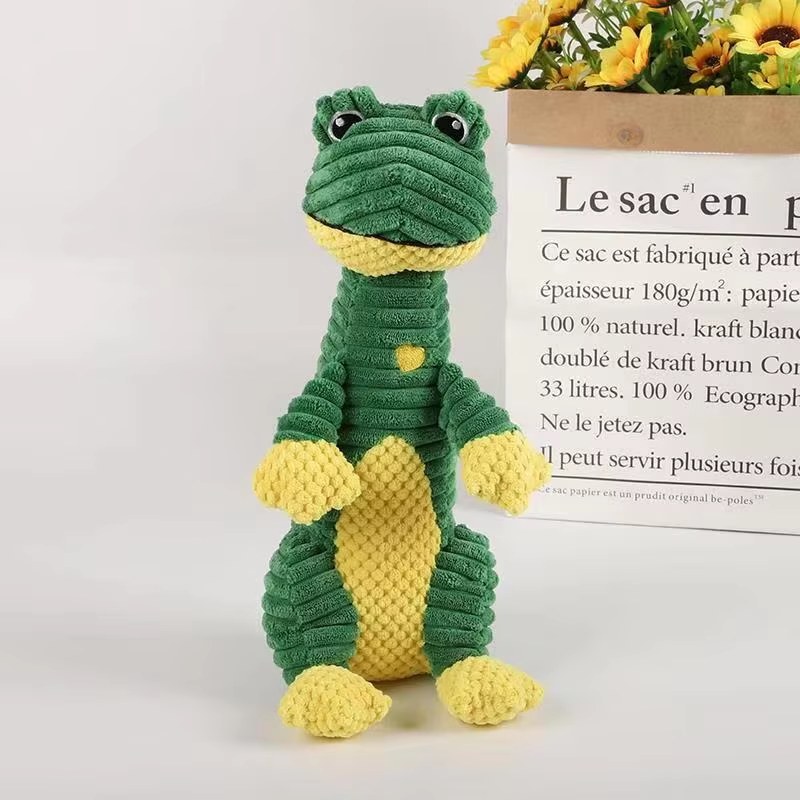
Level 2 — Modified OEM design. You take a stock toy and change what matters to your brand: a different colorway, a longer body, a rope tail instead of a fabric tail, a squeaker moved to the head. For reference, our plush dinosaur squeaker toy regularly ships with customer-specific color combinations. Modifications reuse the existing pattern block, so sampling stays fast.
Level 3 — Fully custom ODM development. You supply artwork or a physical reference toy, and we develop a new pattern, prototype it, and productionize it. This is where a supplier’s real design capability shows: pattern-making, fabric selection, and the judgment to know that a cute sketch is not always a durable toy. Interactive concepts like our hide-and-seek plush dog toys with crinkle and squeaker elements started as exactly this kind of development project.
Before you request a quote, decide which level you are buying. It is the single biggest driver of cost and time in this category.
Section 2/8Fabrics, Filling and Squeakers: The Material Decisions
Plush is one of the few pet categories where the buyer’s material choices change both the look and the durability of the product. Get the specification in writing before sampling. The four decisions that matter most:
Shell fabric. Short-pile plush and super-soft velvet-style fabrics photograph well and feel premium; corduroy and woven patchwork fabrics (like the bears above) resist tearing better on aggressive chewers. Heavier GSM fabric costs more per toy but survives longer — for chewer-positioned brands, we recommend stating a minimum fabric weight in your spec sheet.
Filling. Standard polyester fiber fill is the default; higher-density fill gives a firmer, more premium feel but increases unit weight and shipping cost. If your toy is also a fetch toy, filling density is a durability decision, not just a comfort one.
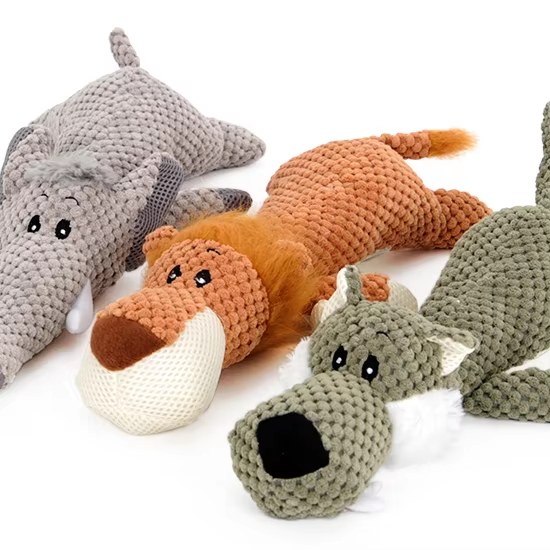
Sound elements. Round squeakers in different diameters, crinkle film, or silent construction — this is a branding decision as much as a functional one. Our soft animal-shaped squeaky chew toys pair a squeaker body with a softer knitted-style fabric specifically because buyers asked for a quieter, gentler “puppy-first” texture.
Accents and combinations. Ropes, TPR, and food-shaped details change the toy’s play pattern. Food-shaped stuffed squeaky chew toys serve cuddle-and-chew behavior in one SKU, and for heavy chewers the same logic extends to double-knot cotton rope chew toys — many buyers run both in one container to cover the full play spectrum.
Section 3/8Safety and Construction Details Buyers Must Specify
There is no single global “plush dog toy standard” the way there is for children’s toys, so construction quality is what protects your brand. Put these five points in every specification:
1. Eyes and noses: embroidered or stitched details instead of glued plastic parts wherever the design allows — glued parts are the first thing a determined dog removes. 2. Seam construction: reinforced double stitching at high-stress points (limbs, tails, squeaker pockets). 3. Small parts: no detachable components that can be swallowed; squeakers must be secured inside a stitched pocket, not loose in the cavity. 4. Squeaker retention: confirm the squeaker stays functional after repeated biting — it is the most common field failure. 5. Labeling: required market markings and a durable brand label attachment method.
At company level, our supply chain is ISO 9001 certified and BSCI audited, and we welcome third-party pre-shipment inspection on plush orders — bring your own QC company or use ours, the door is open either way. That transparency matters more in plush than in most categories, because consistency is hand-labor dependent.
Section 4/8MOQ, Sampling and Tooling
Plush MOQs are driven by fabric MOQs and sewing-line changeover time, not by tooling the way injection-molded toys are. Here is how our schedule works:
| Order Type | MOQ | Sampling | Notes |
|---|---|---|---|
| Stock design, no branding | 10 pcs | Not required | Ships in about 7 days |
| Private label (logo / label / packaging) | 500 pcs | 1–2 weeks | Fastest branded route |
| OEM (modified stock design) | 500 pcs | 1–2 weeks | Colorways and components negotiable |
| ODM (new pattern development) | Quoted per design | 1–2 weeks per sample round | Pattern-making quoted separately |
Two practical notes. First, fabric is where MOQ surprises live: a fully custom colorway may require a minimum fabric dyeing run, which is why some ODM projects carry a higher MOQ than the 500-pc baseline. Second, keep the number of sample rounds low by locking your specification before the first sample — every extra round costs one to two weeks.
Section 5/8Lead Times and Payment Terms
Plush production is schedule-driven by hand labor, so a supplier’s answer to “when can you ship?” should be specific to your order, not a brochure number. Our standard reference points:
| Stage | Typical Timing | What Moves It |
|---|---|---|
| Quotation response | Within 24 hours | Complete spec = faster quote |
| Pre-production sample | 1–2 weeks | Locked spec, reference toy provided |
| Stock orders | About 7 days to ship | Existing SKUs, no branding |
| Custom production run | Quoted per order | Quantity, fabric dyeing, peak season |
On payment, we work with T/T, L/C, PayPal and credit card, and we will match terms to order size — first orders typically run T/T with a deposit, established partners can move to other structures. One planning tip: combine your plush order with hard-goods categories (bowls, feeders, grooming) in the same container. We ship mixed-category containers to buyers in 30+ countries, and freight is usually the quietest place to save money in this category.
Section 6/8Quality Control: What a Serious Supplier Checks
Ask any plush supplier what they inspect and how often — the answer separates factories from resellers faster than any certificate. On our lines, production, QC and packing run under one roof, and plush toys pass through three checkpoints:
In-line checks during sewing: seam alignment, stitch density and component attachment are checked while the toy can still be corrected cheaply. Post-stuffing checks: filling weight against spec, squeaker function test on every sound toy, and pull tests on labels and accents. Final AQL inspection before packing: a statistical sample from each batch against the agreed AQL level, covering workmanship, cleanliness (plush collects lint — trimming is part of the process), and carton condition.
The same discipline applies across our other soft-goods categories — you can see how we run it in our ceramic pet bowl sourcing guide, and it carries over to plush without modification.
Section 7/8What Actually Drives the Unit Price
Plush pricing is component arithmetic. When you compare quotations, make sure every supplier is pricing the same specification — then the differences come down to these six factors:
1. Fabric consumption — a bigger pattern uses more yardage; patchwork styles use more pieces per toy. 2. Embroidery stitch count — a dense embroidered face can cost more than the fabric it sits on. 3. Component count — every rope limb, crinkle sheet and extra squeaker adds labor and material. 4. Filling density — premium feel has a weight cost. 5. Order quantity — the 500-pc private label run and the 5,000-pc run are different price conversations. 6. Packaging level — polybag versus printed retail box is often a 10–20% swing on the landed unit cost.
For example, an electric bouncing plush ball toy with vibration and voice prices in a completely different band from a hand-sewn squeaky bear because of its electronic components — which is why comparing “plush to plush” without comparing specifications is how buyers end up disappointed.
Section 8/8Private Label Packaging and Retail Readiness
Packaging is where a stock toy becomes your product. From our experience shipping private label plush programs, these are the options that matter:
Woven or printed label sewn into a seam — lowest cost, always present. Printed polybag or header card — the standard for e-commerce and discount retail; includes barcode and compliance markings for your market. Printed retail box — for pet specialty stores; adds cost but supports higher retail pricing. Hang tags with your brand story and care instructions.
Two rules save money here. First, decide packaging before sampling, not after — packaging affects carton calculations and can affect the MOQ. Second, ask for carton marks and export carton specifications in writing: plush ships by volume, so carton compression and master carton size directly change your freight cost per unit.
If you are building a full branded range rather than a single SKU, browse the dog toys category to see the current stock platforms — most can carry your label from the first order.
FAQFrequently Asked Questions
What is the MOQ for custom plush dog toys?
Stock designs start at 10 pcs. Private label branding (your logo, label or packaging on an existing design) and OEM modifications start at 500 pcs. Fully custom ODM development is quoted per design, because fabric dyeing minimums and pattern-making effort vary by project.
How long does sampling take?
Typically 1–2 weeks for a pre-production sample on private label and OEM projects, per sample round. ODM development takes one round per iteration — locking your specification before the first sample is the best way to keep the schedule tight.
Can you add my logo and packaging?
Yes — woven labels, embroidered logos, printed polybags, header cards, retail boxes and hang tags are all supported from 500 pcs. For e-commerce sellers, barcode labeling and market-specific markings are routine.
How do you make sure the toys are safe for dogs?
Construction is the safety system in plush: embroidered or stitched eyes and noses instead of glued parts, reinforced double stitching at stress points, squeakers secured in stitched pockets, and pull tests on labels and accents. Production, QC and packing run under one roof under an ISO 9001-certified, BSCI-audited supply chain, every batch passes a final AQL inspection, and third-party pre-shipment inspection is welcome.
What payment terms do you accept?
T/T, L/C, PayPal and credit card. First orders typically run T/T with a deposit; terms can be matched to order size and cooperation history.
Do you provide samples?
Yes. Stock designs can be sampled so you can evaluate fabric and construction before committing. Custom sample costs are quoted per project and credited against your production order in most cases.
CTARequest a Quote or Free Sample
Ready to build your own plush dog toy line? Manufacturing since 2010 and supplying pet brands in 30+ countries, we keep the first step simple:
Request a Quote
Get a Free Sample
Send your artwork, a reference toy photo, or just a rough idea — you will receive MOQ, unit pricing and lead time within 24 hours. Prefer to talk first? WhatsApp +86 153 5610 2970 or email support@timopet.com — you speak directly with the team that runs production.